Stonehenge Lives!?

Getting warmed up...

Getting warmed up…

Hello all, especially former Stonehenge Circus bandmates–

I’m afraid this might be one of those stories my wife Nancy has heard a hundred times, but she was kind enough to mention that the annual Summer Solstice invasion of the real Stonehenge by modern-day Druid Hippies has made the news.

I was traveling through England and Ireland in 1980 and didn’t pay much attention on the ferry from Dublin to Wales (my memory is hazy on where we actually landed) when the guy sitting next to me was leafing through a large book on Stonehenge and Druids.  Anyway, in the course of my travels I was supposed to visit some fun, interesting relatives in Cardiff and some dull, dull old relatives along the way who ran a little bed and breakfast now that their kids had left the nest.  They lived near Stonehenge (Salisbury maybe?) but insisted the old rocks were a bore and not worth wasting my time visiting.  But having played in a band named Stonehenge Circus, I felt a duty to pay my respects.  For a supposedly dull place, however, the train station was bustling when I got off.  I got chatting with a “family” walking over to a psychedelic taxi and when it turned out they were also headed for Stonehenge, I accepted their offer to share the ride.  Turned out they were modern Druids, and when I got there my eyes just about jumped out of their sockets.  The “cab” stopped in the midst of a gathering that would have given Woodstock a run for its money.  There were plenty of booths selling the usual hippy paraphernalia, but there were plenty more selling neat little packets of about every drug I had ever heard of and more than a few I had not.

And then I walked over to Stonehenge itself.  Normally cordoned off and protected by Bobbies, the ropes were down and the guards were taking a long coffee break.  Jungle drums were playing joyfully and like a scene from Hair, hundreds of neo-Druids were dancing wildly on TOP of the monoliths.  A few of the dancers were wearing feathers and ribbons, but that was about it.  There was a young American couple standing nearby, their jaws agape, trying to take a few pictures.  They were from Iowa, on their honeymoon.  And life in Sioux City was never going to be the same.

Happy Summer Solstice wherever you are!
(6/22/15)

Addendum– My Stonehenge Circus bandmate, Peter Wood, sends along the following link that captures the neo-Druid spirit wonderfully– Spinal Tap performing “Stonehenge” at the Glastonbury Festival–  https://www.youtube.com/watch?v=6Ec1WaFrK8E

Halfway Through the Panama Canal

Panama_Canal_-_Pacific_Side_Entrance

Since I was stationed in remote Ubon, Thailand, back in 1971, I often thought about living here, wondering what it would have been like to muster out and become an upcountry English teacher.  When I came back for the first time in 1987, I was again charmed by the families of Thai friends from the States who would take me into their homes and guide me to bus or sangthieu stops or train stations or airports–wherever I needed to go for the next leg of my journey.  Even complete strangers would share a picnic lunch with me when I asked to take a picture.  I could get from provincial capital to capital in the North and Northeast on twin-engine prop planes flown by Thai domestic.  And I could get everywhere else I wanted to go by train. I was still in my thirties and sleeping in a second class berth on a night train was no problem–and was even recommended as more “sanuk” by the well-to-do mother of my Thai teacher.  And she was right–first class would have been lonesome and boring.  Second class was sociable, and when people started turning in for the night, the dining car was even more sociable.  I was on a special three-month visa that let me visit monasteries all over the country, mostly ones that Jack Kornfield recommended in a small book he wrote while still a monk.  I traveled all over but purposely ended up in Ubon.  Wat Pah Nanachat was a newer monastery built by villagers in the poorest part of Thailand in honor of the many Western students who came to study with the meditation master Ajahn Chah.  After visiting some Thai friends in Ubon, I climbed into a sangthieu and headed out there.  And for me, struggling to survive in the jungles of the Hollywood film industry, walking through the gates of Wat Pah Nanachat was like coming home.  Which now got me thinking about becoming a monk.

I was married though, and I had just gotten a promotion to camera operator after a long apprenticeship as an assistant cameraman, so back to LA I went.  In the years that followed the first marriage fell apart, I burnt out on the film industry, met my second wife (who had also burnt out on the business of show), became a small town English teacher after all, and relocated back East.  Through those years I seemed to drift back to Thailand about every five years, gravitating to Chiang Mai as a home base, equally attracted to its monasteries, universities, and many cafes filled with good live music.  By the time my second wife wanted a trial separation, it seemed like my ducks were finally in a row for a comfortable trial retirement in Chiang Mai.

And that was when I began learning the difference between vacationing and actually living in a charming third-world country.  In retirement I had animals with me that my wife was allergic to, so the penthouse condo I dreamed of on the River Ping was out, I discovered.  In fact even finding a house to rent turned out to be difficult.  To their credit, Chiang Mai House persevered and found me a perfect place at the foot of Doi Suthep, just north of Chiang Mai University.  It had a detached office with a majestic panoramic view of the mountain.  Pretty close to perfect.

Except I had an absentee landlord.  The water pump started staying on for days at a time.  I was certain it was going to burn out.  Somehow it didn’t, but at random I had no water.  And then one day while guests were staying here, it flooded, sending them off to a hotel.  My original realtor–who had found me a car, got it insured and registered, and done countless other favors–suddenly disappeared.  And the water went out again.  My neighbor was an old friend of the landlord and couldn’t have been nicer about ringing him up for help.  Except she only spoke in rapid Lanna Thai dialect.  Finally the entire staff of Chiang Mai house came out, talked to the neighbor, and helped me label the extensive city-water/well-water foolproof system.  It went out once more and the labeling turned out to be impossible to follow.  As a last resort, I lit some incense and set some food out to appease the “pii”–the little house spirits that were haunted the house.  The new lead saleslady at Chiang Mai house asked cynically, “Do you really believe in that?”  I don’t believe in it, but don’t tell the “pii”–because they’ve been leaving me alone.

I studied Thai intensively, knowing that I had never been good at foreign languages, but I immersed myself in it.  And the more I learned the more I realized how different Thai and Western languages are.  Full of idioms and little riddles like words that can be used as nouns, verbs, adjectives and prepositions.  Realistically a three-year project i now see.

I also discover that getting my American meds over here is a major project.  I qualify for an APO box at the American consulate, but because meds from the VA and Blue Cross were packed together, they were sent back for being overweight.  My wife sent them directly to my house, very costly but seemingly simple–until the third package was confiscated by Thai customs, who informed me that you’re supposed to buy all you drugs here.  It didn’t seem to faze them that my blood thinner to prevent strokes is not available in Thailand.  And then there turns out to be another regulation that makes them hold them here a month before sending them back.  So even though I am scheduled to be in the States in July, they may not arrive in time.

Long story short, I feel like I’m halfway through the Panama Canal, that point where you are halfway between the level of the Atlantic and the Pacific. And I’m feeling like I don’t know which way to drift–East or West.  I love the food here, there is nothing more delicious and nutritious in the world, but many of the roads a barely wide enough for two motorbikes to pass.  I had two accidents in fifty years of driving in the States and in a single year, two Thai drivers have run into me.  I thought it might be old age catching up with me, but a recent article in City Life magazine showed that Thailand has the second highest highway fatality rate in the world.  The street to my house is laughable–it has a center line but it’s really only a single lane wide.

There are 700 channels on Thai cable, but no PBS, MSNBC, Showtime or BBC Entertainment.  Lots of HBO but no schedule to know when things will be on.  And when CNN and BBC News where shut down during the coup last year, it was downright creepy.  Thai movie theaters can be fabulous but only show mindless action movies.  Worst of all, no Netflix.

Thai people in general are warm and friendly, but I no longer feel the love from the Thai government.  When I came here as a tourist life was easy–you got a thirty-day visa at the airport on arrival.  Now after jumping through many hoops to get a one-year Retiree Visa, I find out I still have to report in every ninety days.  It seemed like my visa was being extended every time I left the country, which seemed too good to be true, so I made a special trip to the immigration office and verified that my visa was now extended from March to November.  And then at the airport in March I find out it was only extended if I stayed in the country till November.  Under some kind of Catch-22 I wasn’t going to be allowed back.  This was a midnight flight I  was about to board and they asked for passport pictures!  “Luckily” it turns out that the immigration office at the airport just happened to have a camera on hand, and somehow we muddled through some sort of visa extension–that I completely failed to understand.

Part of my attraction to Chiang Mai was Jam Night at the North Gate Jazz Club.  The drumming was so good I just sat it on congas, but once I moved here, Tuesday jam night led to Thursday, Sunday and Monday jam nights.  Maybe a little competition helped, because my drumming improved.  But it was also a flashback to why I got out the film biz–I loved the work, but waiting for a call killed me.  And now, even playing for free, it seemed like there were ten drummers waiting around everywhere I played.  If an American drummer returned home, three Aussie drummers would take his place.

And then the wakeup call–I think it had something to do with attending a friend’s funeral and burying two cats the same day.  But it suddenly hit me I had come here to work on a third novel, and I really didn’t have a damn thing to show for it.  Lots of notes, but nothing new, coherent, polished.  And my hearing was getting worse, something I was painfully aware of when I joined two writers groups.  The drumming had to go.  Except guitar players I really dug begged me not to quit, told me they needed me in a new group.  And after backing off, I get called up on stage at Papa Rock’s last week and play for over an hour….  I now realize Chiang Mai is too small a town for me to duck out of the music scene.  If I am really going to get serious about the writing and carve out the many hours it takes, it means going back to the sleepy suburbs near the Jersey Shore.

I have to admit I had a fantasy of meeting a sweet Thai girl and living happily ever after when I arrived last year.  Several of my Aussie friends seem to have done just that.  But I’ve heard countless horror stories of unsuspecting Western men marrying Thai women and ending up cleaned out in a divorce.  Or in other cases being cleaned out before they even got married.  I have been dismayed to discover that the level of English proficiency has gone down here since the Seventies.  Even my very good Thai teachers at AUA and the YMCA here have pretty limited English skills. The reality is that Thailand no longer depends of US military and foreign aid.  Chinese and Japanese tourists flood Chiang Mai now, and Russian tourists are flooding the beach resorts.  Learning late in life how important communication is in a relationship–and how disastrous poor communication was in my two failed marriages–I can see that for me, anyway, a serious relationship here would be a long shot at best, given my limited ability to master Thai and the few women I have met fluent in English.  And now, leaving me truly stuck in the middle of the Panama Canal, is the fact my wife is reconsidering…and getting me to agree our marriage might be saved.  There are probably no two women on the planet less alike than a Jersey girl and an Issan Thai country girl.  But thanks to Skype I am finally looking deep into my wife’s eyes when we talk.  And she’s got a lot to say.

So it’s all settled, I’m going back to give it another shot.  And then one of my VFW pals says, “Oh yeah, I’ve been there.  It’s great for a couple of days and then it all goes to hell.”  Like he was looking over my shoulder that last time I was back.

But I’m going and I need to set up another visa extension.  And the official at Thai immigration couldn’t have been nicer or spoken better English.  Especially when he explained how I can easily renew my year-long Retiree Visa in November when the extension runs out. I’m finished in thirty minutes.  And he gets me thinking, God, I LOVE this country!  (6/21/15)


Blessing of the Bar Girls

Blessing of the Bargirls 2Blessing of the Bargirls 1

Back in October I had just finished up at the Monday Night Jam at Boy Blues Club in the Kalare Night Market, a colorful tourist-oriented part of Chiang Mai not far from the River Ping.  I hadn’t gone on till late, played hard, and now it was time for some shuteye.  The main way into the Night Market by car from the old walled city is Loi Kroh Road, kind of a Disney version of a Red Light District. Barely wider than an alley, it is lined with a mixture of good and ratty restaurants, fancy and semi-fancy hotels, and massage studios mostly offering foot massages to weary tourists but with a wider menu in back.  Mixed in with this are clusters of little bars and pool halls that remind me of the clubs in Ubon, Thailand, when I was stationed there during the Vietnam War 45 years ago.  The clubs in Ubon were bigger, louder, featured lots of dancing to live music, and lots of smooching and hand-holding that would have been shocking for traditional Thais, but all of this was behind closed doors.  Loi Kroh is strange for me because, like Disneyland, plenty of couples and families walk the streets outside, but the bars and pool halls are almost like little stage sets with only three walls.  What goes on “behind” the missing fourth wall is shocking for me as someone who tried to respect traditional Thai culture—lots of attractive, skimpily dressed young girls trying to lure customers inside by acting brassy and raunchy, very un-Thai in a land of delicacy and grace.  And instead of young GI’s, the clientele now is mostly older Western men.

I was invited to visit Stairway to Heaven when I first moved to Chiang Mai. The owner happened to a classmate of mine in a Thai language class.  But the aggressiveness of the girls blew me away.  In the old days in Ubon, the girls helped sell drinks, but they put on a pretext of being customers like the guys.  Whatever else happened was up to the girls.  It might be a one-night stand or she could end up living with a GI.  A few ended up getting married and moving back to the states.  Now, though, the customers were old enough to be the girls’ fathers or grandfathers.  It gave me a strange flashback to my days at Ubon, but with the uncomfortable sense of these guys being stuck in in the past while their bodies had cruelly aged.  My friend wasn’t even there, it turned out, and I graciously slipped away, laughing at the brazen lies the girls were telling complete strangers about how handsome and good-hearted they were, especially if they had flashed an ATM card.

I didn’t go back to the bars, given that I’ve pretty much given up drinking, I don’t play pool, and I do not enjoy Thai kickboxing, the main attraction at the end of a pavilion of these establishments.  But I did like to play drums at Boy’s on Monday night, so I ended up parking every week on Loi Kroh or an adjoining alley or side street.

Late October, I knew, was getting near the end of Rains Retreat, the three months during Rainy Season where the monks stop wandering and stay in their home monastery.  Living in the city on my own and busy taking an intensive course of Thai language classes, I wasn’t as in touch as I had been in the past traveling in Thailand and visiting Thai friends.  I didn’t know that that was the night the Retreat ended.

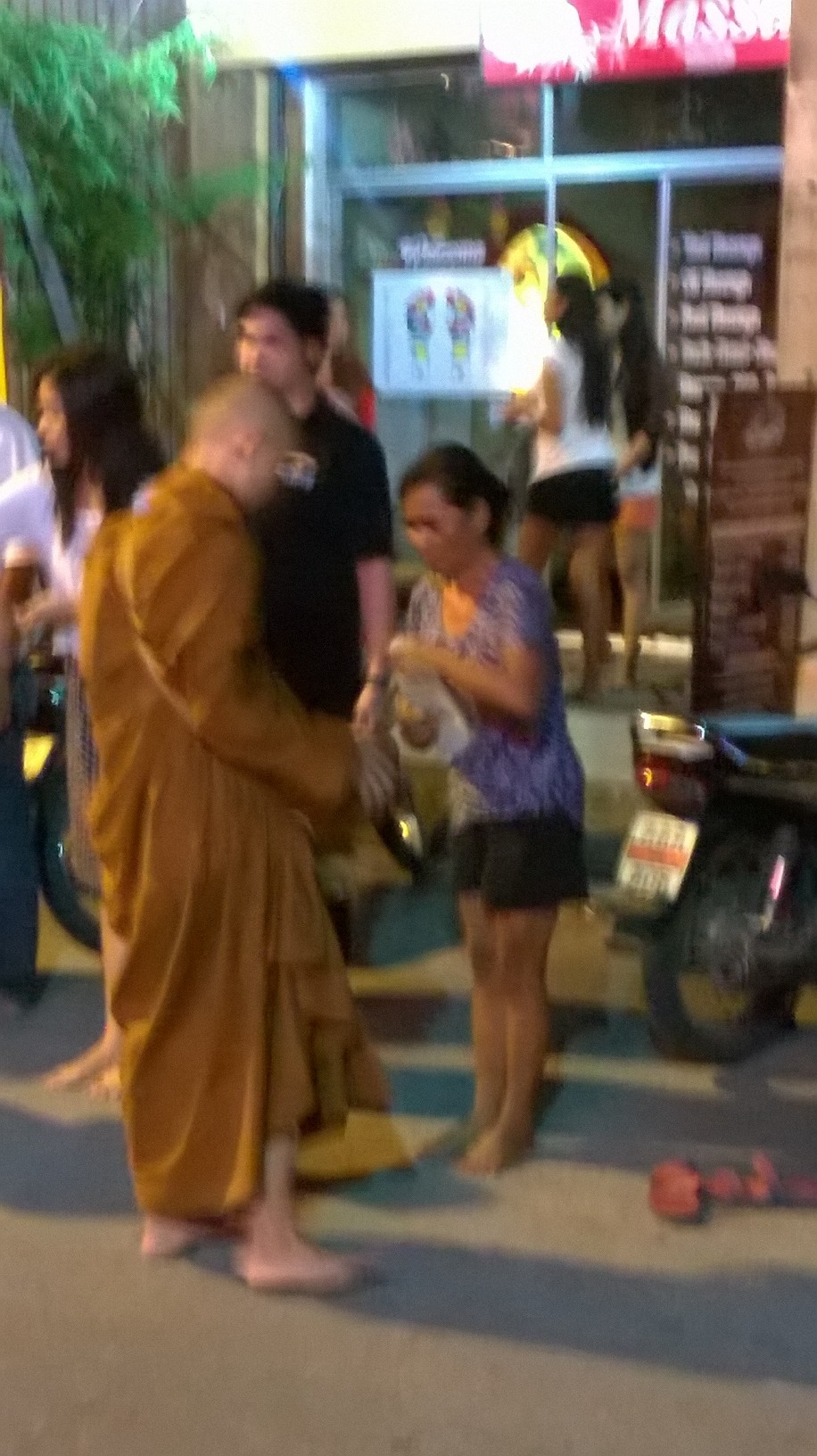
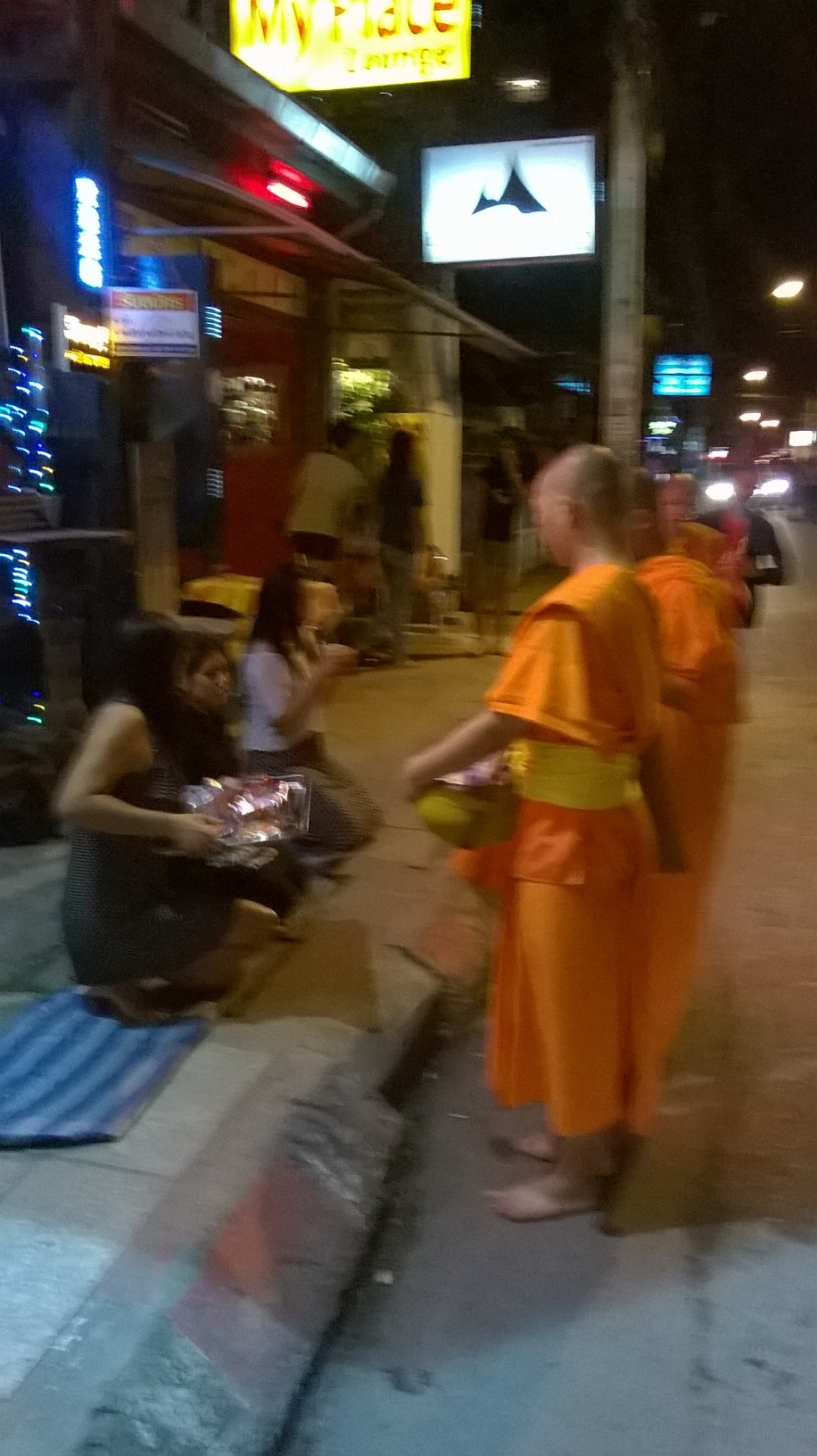
But as I approached my car, an incredible thing was happening.  It was shortly after midnight and hundreds of monks with shaved heads wearing saffron robes were leaving the gates of their monasteries—oh yes, there are also several old monasteries along Loi Kroh, and plenty others nearby.  Little Chiang Mai has almost as many as Bangkok.  And not only were they walking in a large procession down Loi Kroh, they were being greeted respectfully by the same brassy bar girls who had scared me away.  And a couple of interesting things happened.  I started taking a few pictures with my cell phone, no big deal for most people, but I had been a Hollywood cameraman used to big studio cameras and still cameras that weighed a few pounds.  And after twenty five years of looking through an eyepiece, I had little desire to take more pictures.  But this night was special.  I got a powerful sense of how much Buddhism permeates Thai culture, even on an outpost catering to dissolute tourists like Loi Kroh.  The bar girls, along with massage girls, tuk-tuk drivers, bartenders, waitresses and a motley assortment of other Thais who worked there, were kneeling or standing in bare feet, offering food or incense or flowers to the monks.  And the monks, the embodiment of compassion and humility, were chanting blessings to the girls while senior monks sprinkled them with holy water.  And in a new, strange, wonderful way I saw the embodiment of Buddhist interconnectedness (what Thich Nhat Hanh would have called Interbeing) before my eyes.  And I felt blessed to witness it. (6/16/15)

“Cats—NOT the Musical!”

Mama Daeng and Daengdum

Mama Daeng and Daengdum


Big Dam, the Street Cat

Big Dam, the Street Cat

There’s a warning in Chapter 4 of Thailand Fever that if you (a farang, a Western male) marry a Thai woman, expect to be supporting her parents when they can no longer work.  And if she’s an only child, expect them to be living with you.  A cultural switcheroo—Thai children, especially the youngest daughter, NEVER really leave the nest and in gratitude for being born and raised will feel forever indebted to their parents.  But the worst nightmare for a Western male—who thought a mother-in-law moving in was his worst nightmare—is when an entire extended family starts moving in.  I’ve heard the story more than once.  And have been warned.  About Thai women and their families.

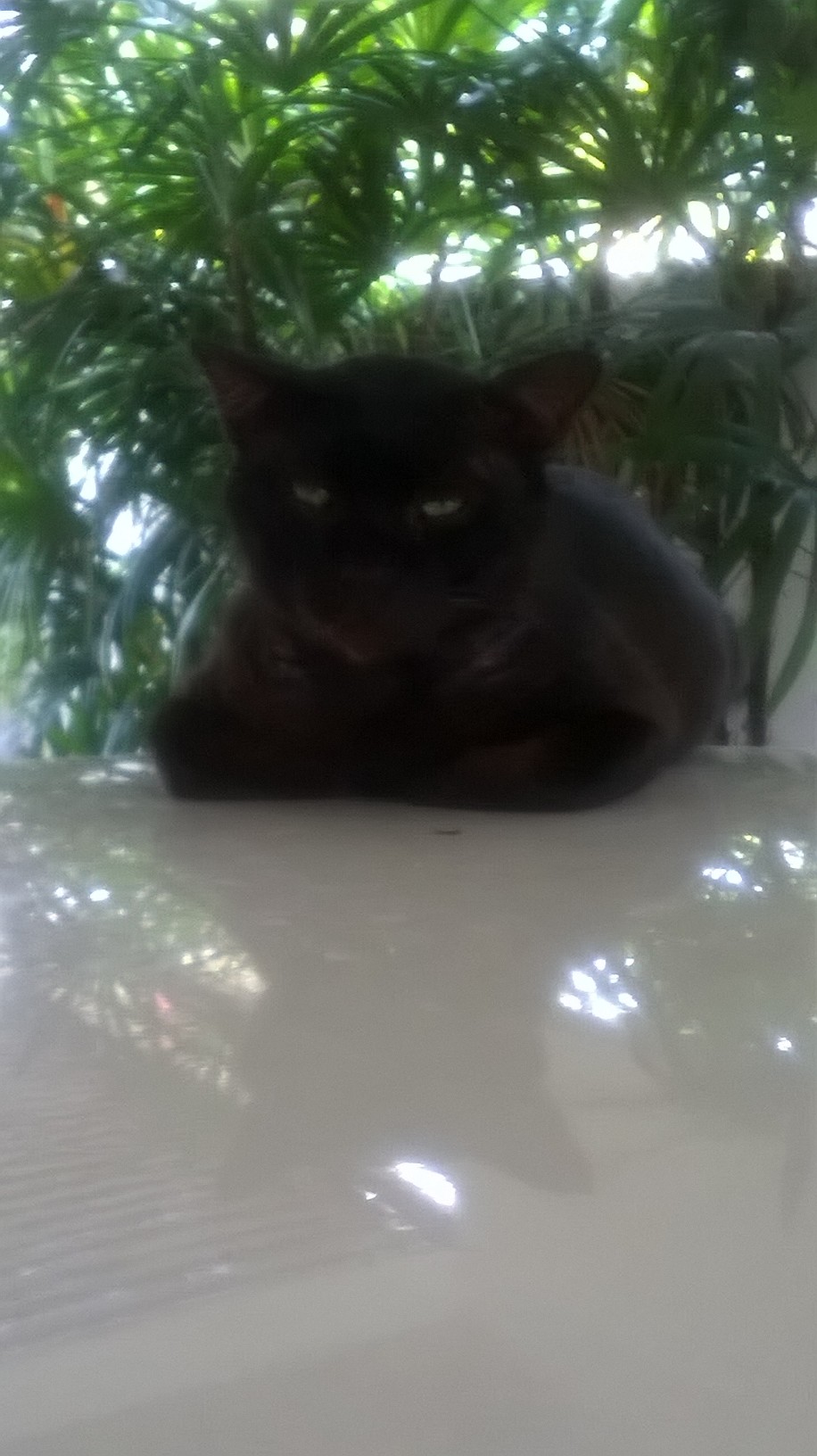
On the other hand, nobody warned me about Thai street cats.  Maybe because there are so many that nobody, especially Thais, pay much attention.  But from my recent experience it looks like the street cats have been paying attention to the Thai families living with farang and decided it was such a good idea they should try it themselves.  I was a perfect patsy.  There was a black street cat already living here when I moved in who spent most of the day sunning out on my deck.  I was a perfect crash-test dummy because I brought two cats with me from the States.  Even though THEY were once street cats back in LA, they were now so domesticated at age seventeen and eighteen that they no longer ate fish, canned or otherwise.  Canned chicken was hard to find and so expensive that I soon figured out it was cheaper to buy a whole cooked chicken.  Given that the old guys were missing a few teeth, I started dicing up the meat and feeding the bones to the big street cat outside.  Soon “Dam” (the black cat) had a girlfriend moving in with him (“Daeng”—a red-coated damsel).  And then “Tau”, the other Alpha Male in the neighborhood, started showing up.

There were many nights that I was awakened by the howling of Tau and Dam.  Many mornings I was greeted by a bloodied Dam outside my front door.  Reading up, I learned that neutered males were less likely to fight.  Dam, happy to be fed, was totally docile when I took him in.  But he and Tau kept butting heads.  When I got back from my annual trip to the States at the end of March, I had a surprise waiting for me.  Daeng had given birth.  And then I discovered that what I thought was a mouse infestation in my office attic was in fact another litter of kittens.  Both the mom and kittens looked an awful lot like Tau—grey with black stripes.  Noi, my housekeeper, fell in love with Tom and Jerry when they fell through the ceiling into my office. Daengdam, the survivor of the outside litter, she decided was “nagliat”—ugly. So the plan was to get Tom, Jerry and Belle (their mom) their shots and spayed or neutered as soon as possible and Noi would take the kittens home.

But the word was out. Two black orphan kittens from across the street showed up, followed by two more of what looked like Tau’s offspring.  When I took Tom and Jerry in for their first shots, Belle and Daengdam were sick, so I brought them along.  Daengdam got some vitamins and cough syrup and bounced back.  Her mom turned out to have feline HIV, something domestic and wild cats can normally live with for years.  But Belle’s immune system was going.  Three sessions of IV fluids didn’t seem to help.  I started feeding her wet food and water with a syringe, but neither one of us were enjoying it.  Another week of IV injections at least bought enough time for Daengdam to finish nursing.  When Daeng couldn’t walk to the litter box, I knew the time had come.  The same day Daengdam lost her mother, I also managed to crush her favorite toy.  She seemed to be depressed the next day.  But the day after that she was tearing around the kitchen, hopping into any drawer I opened, playing with her new toys, and purring like crazy whenever I picked her up.  She had so much personality (did she know she was ugly and had to compensate?) that Noi decided she wanted her after all.

The day Noi was supposed to pick up the kittens was the same day I managed to bring Tau in for neutering.  When I got back I discovered Belle had somehow gotten my office door open.  After the expense of having her spayed and her and her brood given shots, I came home to discover they had run for it.  Noi and I looked all over, managed to find Tom, and then gave up the search.

So life on the street continues. Tom and Daengdam have a new home, but one of the twin orphans was hit by a car.  Dam has mellowed and seems to have taken on the role of mother and father to the surviving orphan.  Tau, though, is as ornery as ever.  I can prevent a fight by feeding them on different sides of the house or threatening to fire up the garden hose. But Little Dam, the orphan Dam adopted, surprised me this morning by walking bravely—or maybe stupidly—between the two growling Alpha Males, and to my amazement breaking up the brewing brawl.

Unlike Dam, I have not mellowed. Three new cats—striped tabbies who look an awful lot like Tau—have showed up.  If they stick around they will be taken in to be spayed or neutered.  But no more shots, which is the strategy followed by several volunteer pet-rescue groups in Chiang Mai.  No more “treats”—Fred and Bart’s leftovers only.  And the neighborhood chickens that I once thought were down-homey wandering through my yard are gone.  Stole too much of the cats’ dry food.  And too much kii-gai (chicken you-know-what) to clean up.

After almost three months of crawling through attics, feeding wild cats until they were tame, trips to the vet, and paying vet bills I really couldn’t afford, I was tired.  And then Noi sent me the pictures of Tom and Daengdam in their new collars playing with their new toys, their coats brushed out and shining, what looked like dog smiles on their faces, and it began to seem almost worthwhile….  (6/11/15)

“Jai Yen Yen” and “Thank you for your service”

Thank You for your Service

Well intentioned, but for me they become empty platitudes.  “Jai Yen”—a cool heart—is a Thai value that can bring out some of the best in Thai culture.  Staying calm under duress, maintaining a flow on a busy day in a bustling town.  But when my electric is out for the second time in a week, I have a language class to get to in a few minutes, and I not only don’t have hot water for a shower, I have no water at all, a cool heart will not get the power back on.  It will not give me a way to contact an electrician.  And it will not get my absentee landlord in the hipster town of Pye (in the sky?) to get off his butt and do anything for me.  I suspect he has interpreted Jai Yen as not getting too excited as you count your money.  And calmly ignoring an entreaty to spend any of it on maintenance.

“Thank You for Your Service” was equally irritating for me when it turned up in American vernacular.  A Pentagon PR-man’s bright idea?  Or did a Boy Scout Troop think it up?  It could be so irritating that in a New Yorker short story a few years back a combat veteran fresh home from the Mideast goes postal when he hears it from his mindless family one time too many.  A family of what a Marine would call Mall Rats.   Mall Rats, who had grown up in suburban America and never left, thanking someone who had been on active duty in wartime for sacrifices they could never imagine.  Having your head shaved and giving up your identity is just the beginning.  It might be as simple as giving up the most productive years of your life, bored to death with a stateside assignment.  It might mean the desperate loneliness of living thousands of miles from home dropped into another culture, unable to speak the language, to engage in any meaningful way, which means living like a Mall Rat, confined to a little patch of American suburbia on a foreign military installation.  But for the men and women at the “point of the spear” and the medics, morgue techs and others just a step behind, it means the potential of having your new best friend die in your arms in Vietnam—and just picking up the body parts in modern wars on terror….

I finally heard “thank you for your service” mean something when I really needed it.  I had lost a job after moving across the country to be closer to my ailing father.  My wife could not understand at all this sudden loss of income and health benefits.  I swore I would never set foot in a VA facility again after seeing the zoo that passed for a hospital in Westwood, CA, in 1973, just after I had started grad school and still had some free dental benefits left from four years of active duty.  But now it was 2009.  The VA had changed.  So when I had to eat humble pie and go to the clinic in Brick, NJ, to get treatment for depression that had dogged me for years, the first words I heard from the woman at the reception counter, a fellow Vietnam veteran it turned out, were “Thank you for your service.”  And she meant it.  (6/9/15)